Skip to content
Milan Club Adelaide crestMilan Club Adelaide

Il Museo Rossonero · Archive

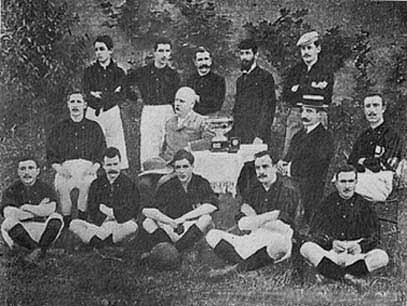
AC Milan in 1899

Era: The Founding

12 stories and 0 matches from the Milan Club Adelaide history museum, in the order they happened.

The stories of 1899

1899

Alfred Edwards, Milan's first president

The founders turned to Alfred Ormonde Edwards, an English businessman and former British vice-consul in Milan, to serve as the club's first president. Born in Shropshire in 1850 and the eldest of the founding group, Edwards lent the young Milan Foot-Ball and Cricket Club the respectability, connections and capital of a man of standing. Herbert Kilpin is the romantic figure everyone remembers, but it was Edwards' anglophile insistence that fixed the club's name as 'Milan' rather than the Italian 'Milano' — a spelling the Fascist regime would later try to erase, but which survived as a badge of origins. He presided from the 1899 foundation until 1909, steering the Rossoneri through their earliest triumphs and the first three championships of 1901, 1906 and 1907, before returning home to England, where he died in 1923. His name stands forever first in the club's roll of presidents.

Sources

Open the interactive timeline

1899

Why it is 'Milan' and never 'Milano'

The founders deliberately kept the English spelling 'Milan' rather than the Italian 'Milano', a nod to the game's British origins and to men like Kilpin and Edwards who had carried football over the Alps. When the fascist regime forced an Italianisation to 'Milano' in the late 1930s, the club bore the name 'Associazione Calcio Milano' only until the war's end, then returned to its English word. It is the oldest surviving syllable of the club's identity, a linguistic fingerprint left by its Anglo founders.

Sources

  • The Lord of Milan (Robert Nieri)
  • Calcio: A History of Italian Football (John Foot)

Open the interactive timeline

1899

'Il Diavolo' — red like fire, black like fear

When Herbert Kilpin and his companions founded the Milan Foot-Ball and Cricket Club in December 1899, they dressed the side in vertical stripes of red and black, and to Kilpin is attributed the immortal declaration that gave the club its soul: 'Saremo una squadra di diavoli; i nostri colori saranno il rosso come il fuoco e il nero come la paura che incuteremo agli avversari' — we shall be a team of devils, our colours red as the fire of the players' ardour and black as the fear we strike into our foes. From that founding image grew the eternal nickname il Diavolo, the red-and-black demon that would decorate crests, banners and songs. Historians treat the exact wording with a biographer's care — Robert Nieri traces how a casual remark may have been burnished by retelling into sacred origin-myth — yet Italian sources cherish the rosso e nero story as the club's founding legend, and the image of Kilpin as spiritual author of the rossoneri identity is central to how Milan remembers its birth. For decades those stripes carried no mark of commerce, only the raw identity of the club, sewn into the earliest hand-made shirts, and the symbolism has clothed the rossoneri for more than a century.

Sources

  • The Lord of Milan (Robert Nieri, 2015)
  • Forza Milan! (club magazine)
  • it.wikipedia.org — Storia dell'A.C. Milan
  • magliarossonera.it
  • Guerin Sportivo
  • it.wikipedia.org
  • The Lord of Milan (Robert Nieri)

Open the interactive timeline

1899 (born Nottingham, 1870)

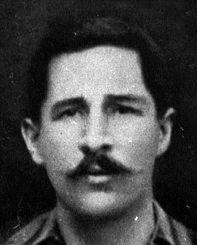
Herbert Kilpin, Father of the Devils

Herbert Kilpin, Father of the Devils

No figure looms larger over Milan's cradle than Herbert Kilpin, born in Nottingham in 1870 and already a football pioneer with Internazionale Torino before he settled in Milan. Captain, coach, talismanic forward and keeper of the club's spirit, he assembled and drove the side remembered as the 'Kilpin XI', scoring in the very matches that brought Milan its first titles. Famously fond of a nip of whisky and utterly devoted to his devils, Kilpin is enshrined as the true father and soul of the rossoneri.

Open the interactive timeline

founded 1899

The red cross of Milano on the crest

From its earliest emblem the club fused two identities into one shield. On one field sat the Croce di San Giorgio, the red cross on a white field that flies as the flag of Milano — the same cross once carried by the city's medieval militias, and tied in Milanese tradition to Sant'Ambrogio, the fourth-century bishop and patron saint whose Ambrosian cross had marked the comune since the Middle Ages. On the other ran the club's own red-and-black bands, le strisce rossonere. The original stemma was a plain shield split vertically, half croce and half stripes, declaring that this English-founded side belonged wholly to Milan, its Lombard home and its people. Across more than a century the shield was redrawn many times, yet the cross, the stripes and the letters A.C.M. endured.

Sources

  • Mondo Milan Museum
  • Forza Milan! (club magazine)
  • AC Milan official club history — 'History: AC Milan logo' (acmilan.com)
  • Civic heraldry of Milano / the Ambrosian cross (Flag of Milan)
  • John Foot, Calcio: A History of Italian Football (2006)

Open the interactive timeline

1899

La Rosea: Milan's Hometown Pink Paper

Born in Milan in 1896 and printed on its unmistakable pink newsprint from 1899 — the very year of Milan's birth, a symmetry dear to Italian football writers — La Gazzetta dello Sport grew up alongside the club, chronicler and subject entwined from the start. From the earliest Palla Dapples matches its reporters were present to record the rossoneri, and the pink pages of 'la rosea' (the pink one) became the near-continuous ledger of Milan's life across three centuries. Its towering front-page headlines on the morning after a triumph turned each scudetto and each European night into a page tifosi cut out and kept; to wake and find the pink sheet roaring the club's glory over breakfast became, for generations, part of the very ritual of winning. It is a shared-origin motif the Italian tradition cherishes in a way no English-language source does.

Sources

  • La Gazzetta dello Sport (archivio storico)
  • it.wikipedia.org — Storia dell'A.C. Milan
  • magliarossonera.it
  • centenary retrospectives of the paper

Open the interactive timeline

1899

Le strisce rossonere: the broad red-and-black stripes

The maglia rossonera has stayed remarkably faithful to itself since 1899: broad vertical bands of red and black, the fiery colours chosen so the team would play like diavoli, 'devils.' While the shorts alternated between white and black across the decades and collars came and went, the wide bande larghe of the shirt remained the club's unmistakable signature, deliberately bolder than the thinner pinstripes worn by many rivals. It endures as one of football's most recognisable jerseys, worn in essence unchanged for more than a century.

Sources

  • AC Milan club museum (Mondo Milan, Casa Milan)
  • La Gazzetta dello Sport

Open the interactive timeline

December 1899

The First Officials of the Rossoneri

The founding members elected Alfred Edwards — a Shropshire-born businessman and former British vice-consul in Milan — as the club's first president, an office he would hold until 1909. Edward Nathan Berra took charge as vice-president and captain of the cricket eleven, Samuel Richard Davies served as secretary, and Herbert Kilpin stood as the player-manager who led the footballers onto the pitch. Around them gathered early members such as David Allison, Daniele Angeloni and Giannino Camperio — the small nucleus from which Italy's soon-to-be dominant club would grow.

Open the interactive timeline

16 December 1899

Milan's birth is carried to the public in the sporting press

When the Milan Foot-Ball and Cricket Club was constituted on 16 December 1899, its arrival was made public through the Milanese sporting press, La Gazzetta dello Sport carrying word of the new club to the city's readers. The founding circle gathered around the Englishman Alfred Edwards, its first president, and Herbert Kilpin, the Nottingham lace-worker who became its heartbeat. That printed notice is, in a sense, the club's true birth certificate: the moment Milan passed from a room of enthusiasts into the public record.

Sources

  • The Lord of Milan (Robert Nieri)
  • La Gazzetta dello Sport

Open the interactive timeline

16 December 1899

The Birth of Milan Foot-Ball and Cricket Club

The Birth of Milan Foot-Ball and Cricket Club

On the evening of 16 December 1899 a small band of English expatriates and Milanese enthusiasts formally constituted the Milan Foot-Ball and Cricket Club. The founding assembly was held at the Hotel du Nord et des Anglais, though Italian accounts commonly locate the christening at the nearby Fiaschetteria Toscana on Via Berchet — the smoky back-room tavern that soon served as the club's first home, and which Italian sources treat as sacred ground: the seed of both the rossoneri and, later, their city rivals. The Englishman Alfred Edwards became the club's first president, while its prime mover was Herbert Kilpin, a lace-trade worker from Nottingham who served the fledgling side as player, coach and captain all at once, and who decreed the shirts should be red as fire and black to strike fear into opponents — and so the rossoneri were born. The club fixed both football and cricket in its very name, betraying its British paternity — cricket was the pastime of the expatriate community Kilpin and his circle brought to Lombardy — and reminding all of the Anglo-Saxon roots from which it sprang. More than a football club rose from that room: a diavolo that would haunt Italian and European football for over a century. Forza Milan.

Sources

Open the interactive timeline

December 1899

A Notice in Pink: The Gazzetta Records Milan's Birth

In mid-December 1899 a group of English and Italian sportsmen around Herbert Kilpin founded the Milan Foot-Ball and Cricket Club, with Alfred Edwards as its first president — and it was the pink pages of La Gazzetta dello Sport that carried the news to the city. The paper's brief notice, published days after the founding meeting, still serves historians as the club's documentary birth certificate, and it sits at the heart of the long-running debate over the exact December date. For Milan's first decades, before radio, newsreels or any club publication existed, the Gazzetta's match reports were effectively the only running record of the rossoneri: line-ups, scores and early championships survive largely because the pink paper printed them on Monday mornings. The bound volumes of those early years remain the primary archive from which the club's pre-war history has been reconstructed.

Sources

  • La Gazzetta dello Sport historical archive

Open the interactive timeline

December 1899

The Thin Paper Trail of the Founding Era

The Milan Foot-Ball and Cricket Club was founded in mid-December 1899, with the news carried in the Milanese press within days, yet almost no physical trace of that first era survives: the club of Herbert Kilpin left behind newspaper notices and civic records rather than an organised archive. Early membership papers, kit and correspondence were scattered or lost across two world wars and repeated changes of headquarters, so historians reconstruct the pioneer years largely from period newspapers. Fittingly, the most moving relic of the founding era is not an object at all but a grave: Kilpin died in 1916 and lay in an unmarked plot for decades until a devoted fan, Luigi La Rocca, tracked down his burial place in the late 1990s. The founder's remains were later transferred with honours to Milan's Monumental Cemetery, turning a rediscovered gravesite into the club's oldest place of pilgrimage.

Sources

  • AC Milan founding accounts
  • Herbert Kilpin grave rediscovery accounts (Luigi La Rocca)

Open the interactive timeline